

25 August 2026
‘There’s a world underground that you won’t be able to see any more soon’
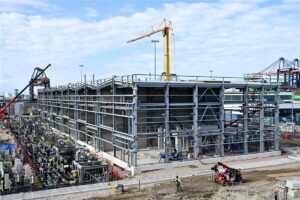
There are no pipes whatsoever beneath the compressor building. But there are plenty beneath the surrounding site. “It’s truly bizarre what lies underground in various places on this site,” says Evert van den Berg, P/M (Piping/Mechanical) Superintendent at Porthos. A large proportion of the pipework will soon be out of sight. That is precisely why it is important to install and check everything properly now.
Underground culvert
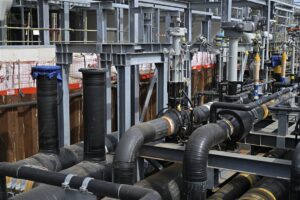
A large proportion of the pipework converges in the culvert, The gallery is filled with piping modules, most of which will soon be hidden below ground level. This is unusual: in industry, such pipework galleries are usually located above ground, so that they are easily accessible for inspection and maintenance.
Amongst the underground pipelines are the CO₂ pipes. The 42-inch pipeline carries CO₂ at low pressure from Pernis to the compressor station. The 16-inch pipeline transports the CO₂, once it has been pressurised to high pressure, onwards to platform P18-A. There are also pipes for transporting the cooling water for the oil and CO₂ plant. The heated water released during this process will soon be put to good use. “We will use this residual heat, amongst other things, to heat our office and maintenance building.”
Everything below ground level
The fact that the culvert will soon lie below ground level calls for extra attention. “If you ever need to access it for maintenance in the future, it will be quite a major undertaking: the sand will first have to be dredged away to gain access to the pipes. That is why it is essential to pay very close attention now to the choice of materials, inspections and quality controls. “The pipes, for example, have a PE shell – a plastic protective layer that is highly resistant to salt and groundwater. Aluminium is not an option at all in an area like the Maasvlakte. In fact, you’re in an offshore environment here that places very high demands on the equipment.”
Quality you won’t see later on
As the pipework will soon be largely hidden from view, any weak points must be detected at an early stage. The coating is therefore subjected to extensive testing. One such test is the holiday test, or spark test. “It’s got nothing to do with holidays; it’s a technical term from the coatings industry,” says Evert with a laugh. “The spark test checks whether the coating is completely intact and contains no tiny holes, cracks or other damage anywhere. If you do find any, you can apply an extra layer so that the coating is guaranteed to last for decades.”
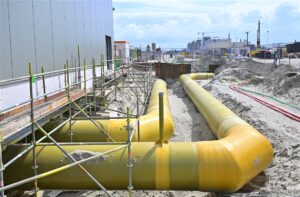
Around the heat exchanger building, too, a tangle of pipes is being buried underground. For example, the GRE pipe is still visible at the moment, but it will soon be covered with sand. Although GRE is not susceptible to corrosion, it remains essential to work with care. “Small stones or pieces of shell, for example, can cause leaks. That simply must not happen. That’s why we’re constantly monitoring quality here too, with checks and inspections.”
One chance to get it right
For Evert, ensuring quality is therefore the biggest challenge of his work on this project. “That quality really must be optimal and carried out with precision. There’s only one chance to get it right, and that’s now. So we’re keeping a close eye on it.”
These checks begin as early as the prefabrication stage. The material is then checked again before and during installation. “It might seem like a duplication of effort, but it’s necessary for pipework that will soon be largely inaccessible. What we’re installing with such care now must function reliably for years to come.”
Ready for the future
Furthermore, the design of the compressor station has already taken future expansion into account. “Space has been set aside in the compressor building for the expansion of Aramis, as well as for the pipework.” In this way, we are not only building today’s infrastructure, but also laying the foundations underground for tomorrow’s CO₂ infrastructure.