
30 September 2026
‘If the conditions are right, you can solve almost any problem together’
Thirty kilometres of 42-inch pipeline, eleven valve stations and a route cutting right through one of Europe’s busiest port areas. Denys and Porthos were faced with a complex challenge, in which not everything could be foreseen in advance. Instead of trying to iron out all the uncertainties, they opted for a two-phase contract and close collaboration. Now that the construction of the onshore pipeline is entering its final phase, project manager Tom Leys of Denys and contract manager Bert Nap of Porthos/Port of Rotterdam Authority look back. Their conclusion: ‘If the conditions are right, you can solve virtually any problem together.’
The Porthos project is one in which not all uncertainties can be identified in advance. An initial tender round did not result in a contract being awarded. ‘I came on board as contract manager,’ explains Bert Nap. ‘On the condition that we would approach the tender process differently. We opted for a different contract form and turned it into a two-phase contract. In such a contract, the contractor is involved right from the preparatory phase, contributes ideas to the design and has a say in the conditions under which the work is carried out. Denys went along with this from the start. They literally helped draft the contract. In my view, that laid the foundation of trust.’
Don’t tie everything down in advance
According to Tom Leys, this is a key difference from a traditional contract. ‘A standard building contract sets out what you must do, but not what you must not do. There’s always a grey area there. At Porthos, we recognised that there were some things we couldn’t know in advance. We made those uncertainties explicit and set them out in a Risk Allocation Matrix. We sat down together to work this out. I really appreciated that transparency in the preliminary phase. It prevents any potential disagreements during the execution phase.’
Bert adds: ‘It is precisely that preparation that is a key advantage of the two-phase approach. You can try to think of everything in advance and put a price on it, but in practice things often turn out differently. So you need to have agreed in advance how to deal with such a situation.’
Collaboration can be fostered
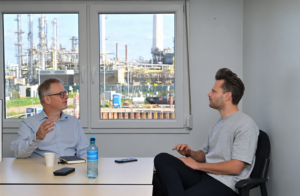
For Bert, effective collaboration doesn’t just depend on the people sitting opposite each other at the table. In his experience, the circumstances in which they have to carry out their work are just as important. ‘It’s often said that smooth collaboration depends on the person on the other side of the table. But from my perspective as a client, that person is subject to the conditions in which they operate. It’s the client’s role to ensure that those conditions are such that someone can behave normally.’
According to him, this also calls for self-criticism. ‘If the collaboration is running into difficulties, as the client you must first identify which conditions are preventing the contractor from doing their job to the best of their ability.’
Solve the problem first, then discuss it
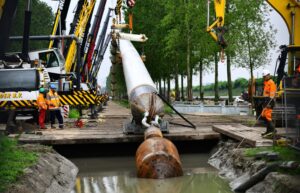
A good example was the HDD drilling beneath the Caland Canal. Whilst pulling the pipe in, the line became jammed. ‘You end up with an extra problem if you start by trying to determine whose fault it is,’ says Bert. ‘That’s why we sat down together straight away. Denys and Van Vulpen had a pipe pusher flown in from Germany and resolved the problem very quickly. Speed really was crucial, because as the bentonite hardens further, it becomes increasingly difficult to pull the pipe into the borehole.’
Tom recognises this approach. ‘It’s typical of how Denys operates: we look for the solution first, so we can get on with the work. Only then do we consider the contractual and commercial implications.’
That approach did not mean the contract was pushed into the background. ‘Certainly not,’ emphasises Bert. ‘We had an agreement with clear responsibilities and figures. At various points, we acted formally, in accordance with the contract, and set things out in writing.’
Tom also emphasises the importance of that formal structure: ‘We had weekly contract meetings. These were open and transparent discussions, but we did follow the processes we’d agreed upon.’
Moving forward together under pressure
The schedule also put pressure on the collaboration. Tom refers to this as ‘healthy pressure’. Valves delivered late and design changes at the Pernis station caused delays. ‘As a contractor, you can then say: we won’t do any more work until there is clarity on the schedule and finances,’ says Tom. ‘I had to convince my team to take the risk and carry on working. We knew it would all work out.’
To resolve the issues, staff from Porthos and Denys held a one-day brainstorming session. ‘We looked at every single point and said: we have to sort this out today. We had to find a solution. And we succeeded.’
Lessons learnt
Now that the work is heading towards final handover, both look back on a collaboration in which trust and clear agreements reinforced one another. ‘In my opinion, Porthos has proved to be a good reference for tendering and contracting complex projects according to the two-phase concept,’ says Bert. ‘The benefits have proved themselves as intended.’
Tom cites sufficient preparation time as a key prerequisite for a successful collaboration. ‘That allows you to agree on matters in a different way, for example via a Risk Allocation Matrix. But ultimately, it’s also about trust – and the time spent in the preliminary phase plays a major role in determining that too.’
Bert sums up the key lesson: ‘As a client, you need to create the conditions in which a contractor can perform as normal.’ ‘Once that foundation is in place,’ adds Tom, ‘even if something unexpected happens along the way, you can continue to work together to find a solution. Ultimately, that’s what made the difference here.’