

16 July 2026
From Porthos pioneer to new energy infrastructure: Helen Miley opts once again for ‘same, same but different’
She worked as Director Execution at Porthos for exactly four years: Helen Miley. We spoke to her about the development of the CCS project, the professionalisation of the organisation and the lessons she is taking with her to her next challenge. In August, she will take up the post of Deputy Project Director at the Delta Rhine Corridor (DRC), a major Dutch-German infrastructure project for the energy transition.
The DRC also focuses on CO₂ infrastructure and thus shares parallels with Porthos. At the same time, the project presents new challenges, partly due to the integration of hydrogen and cross-border collaboration. This ties in with the expression Helen often uses: ‘same, same but different’. A description that aptly sums up her time at Porthos and now applies once again to her next step.
Four years of building a unique project
“When I joined Porthos in August ’22, the organisation was on hold, awaiting the permits. That’s a challenging time to come on board, because at that stage there’s still no certainty as to when you can actually start implementation. At the same time, the whole organisation is raring to go. My remit was clear: to deliver the project.”
Over the following four years, the organisation became much more professional. In doing so, Porthos was able to build on the procedures and experience of its shareholders: Gasunie, the Port of Rotterdam Authority and EBN. Nevertheless, Porthos itself was very much a first-of-its-kind project. This makes it fundamentally different from a standard oil and gas project or pipeline project. “During my first year at Porthos, the team and I set up a great deal. That was necessary because we were doing something that had never before been achieved on this scale in the Netherlands or even in Europe.”
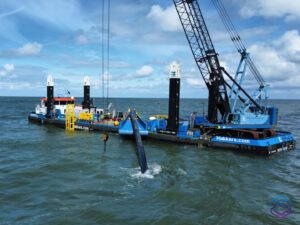
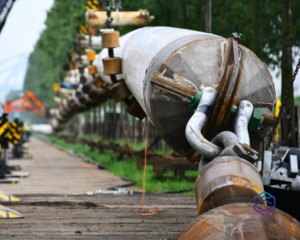
“Together, we have achieved a great deal over the past few years,” says Helen. “For instance, the necessary permits were obtained, the Final Investment Decision (FID) was taken, the onshore and offshore pipelines were laid and connected, the compressors have now arrived at the compressor station, and former gas wells have been converted into CO₂ injection wells. They have been four intense, but above all wonderful, years. What I am perhaps most proud of is that progress was made every single day. That is not the achievement of one person or one organisation, but of everyone connected to Porthos: government, customers, contractors, suppliers, shareholders and, of course, all Porthos employees.”
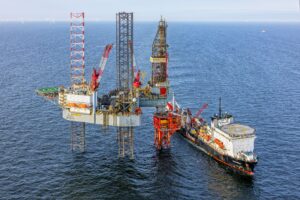
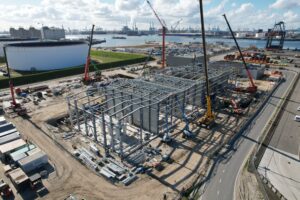
Realising a complete CCS chain
According to Helen, the complexity of Porthos lies primarily in the innovative nature of the project. “Unlike many other infrastructure projects, we are not just building a pipeline or a facility, but creating an entirely new value chain in collaboration with our customers. From capturing CO₂ at industrial sites, through transport and storage, to injection and permanent storage in depleted gas fields beneath the North Sea. And we are building all of this with the potential to scale up the CO₂ network further in the future. A“All the elements must be technically, legally, contractually, financially and operationally sound and fit together seamlessly. It is precisely this integrated approach that makes Porthos unique and complex.”
Collaboration as the key to success
When asked about the most important lesson she has learnt during her time at Porthos, Helen doesn’t have to think long: in her view, collaboration is the key to success. “With a first-of-its-kind project like this, it’s impossible to foresee everything in advance. You know you’ll encounter situations along the way that require a different approach to the one you’d originally envisaged. It’s precisely then that it’s important not to dwell on what might have been, but to pull together. There is no other option.”
According to Helen, it is essential to realise that no single party holds all the pieces of the jigsaw. “You put the jigsaw together as a team. That requires listening carefully, being open to each other’s perspectives and understanding the different interests and areas of expertise. “With complex and innovative projects, you can only make progress if you truly understand all the different aspects and perspectives. Collaboration is not a secondary consideration that comes into play later on; it is a key factor for success right from the start.”
New challenge at Delta Rhine Corridor
On 15 August, Helen will start as Deputy Project Director at DRC. The project focuses on the construction of underground pipelines for the transport of CO₂ and hydrogen between industrial areas in the Netherlands and Germany. Helen: “This, too, is ‘same, same but different’ compared to Porthos. There are clear similarities, such as the transport of CO₂, but also significant differences. DRC combines CO₂ infrastructure with hydrogen and also has an international dimension.”
Helen is looking forward to working on another energy transition project. “For me, working in the energy sector means contributing to a sustainable future. I’m also really drawn to the challenge of a complex project like DRC.”
DRC is currently still in the preparatory and licensing phase – a phase Helen recognises from her time at Porthos. “I’m bringing my experience from Porthos in taking projects to FID, as well as the knowledge I’ve gained on CO₂-specific topics.”
Sharing knowledge for the next generation
For Helen, it is important that lessons learnt from projects such as Porthos are shared actively within the energy transition. “There are plenty of reports and studies available, but you make the biggest difference by sharing knowledge through people with practical experience: what works, what doesn’t, what were the specific circumstances, and what lessons can be drawn from this for future projects?”
Helen looks back with pride on the people at Porthos. “That’s also what I’m going to miss the most,” she says. “It’s amazing to see what you can achieve together with a group of passionate people.” This drive is not only found within the Porthos organisation, but also among our clients, our contractors and suppliers, and our shareholders. These are the pioneers who have put their heart and soul into – and continue to do so – the successful realisation of Porthos. Such driven and knowledgeable people are indispensable to making an innovative project like this a success.
I wish everyone involved in Porthos every success with the upcoming phases of the project.”