

30 June 2026
Complex conservation operation completed successfully: existing wells ready for a new lease of life
The Porthos project is giving existing offshore infrastructure a new lease of life. Part of the project involves the reuse of the P18-A platform and four existing wells that were originally constructed for gas production. By converting the platform and the wells to make them suitable for CO₂ injection, not only is existing infrastructure utilised, but an innovative contribution is also being made to the energy transition.
Conductors: crucial components of the well structure
An essential part of these wells are the so-called conductors: the outer pipes that rise visibly from the sea at the base of the platform. These conductors fulfil an important structural function: they support the weight of all the tubing suspended from the wellhead and are therefore continuously exposed to significant compressive loads. As they are freestanding and not structurally connected to the platform, their condition and reliability are of great importance.
Corrosion after thirty years at sea
After more than thirty years in the North Sea, the existing conductors on the P18 platform showed clear signs of corrosion, particularly in the so-called splash zone: the area around the water’s surface where steel is subjected to particularly severe stress due to alternating exposure to seawater and air. Measurements showed that, whilst the remaining wall thickness was sufficient to allow safe CO₂ injection into the depleted gas fields in the North Sea, the wells would need to remain operational for more than twenty years as part of the Porthos project, so additional preservation measures were necessary to prevent further deterioration.
A new technical challenge calls for a new solution
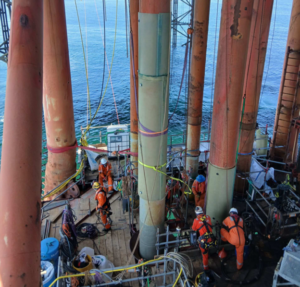
The reuse of existing wells for CO₂ injection is a relatively new approach. This also gave rise to a new technical challenge: how do you protect ageing conductors against further corrosion in the long term? The chosen solution consisted of a combination of thorough cleaning and a protective epoxy coating. The work began with the complete cleaning of the conductors. Fibreglass shells were then fitted around the pipes. Next, epoxy was pumped in stages from below into the space between the conductor and the fibreglass structure, creating a sealed protective layer that prevents further corrosion.
Diving operation under challenging conditions
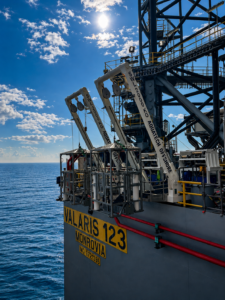
Initially, the plan was to carry out this preservation work simultaneously with the refurbishment of the wells. As a large part of the work was to be carried out below and just above the water’s surface, the possibility of using robots was investigated. Ultimately, it was decided to employ specialist divers. They carried out the work from the Valaris 123, once the well conversion operation had been completed.

Safety and efficiency first
The diving campaign began in May 2026, following an extensive preparatory phase in which safety and efficiency were paramount. The operation was complex: teams from various companies were working simultaneously at multiple levels – underwater, above water and on different decks of the platform. This was compounded by additional risks such as working with chemicals, hoisting operations and pressurised fluids. This combination made the campaign technically challenging and placed high demands on planning and execution.
From preparation to execution
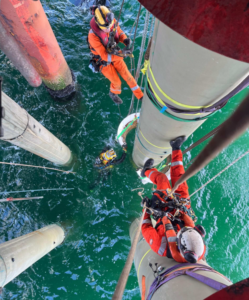
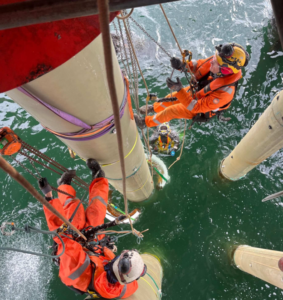
After the conductors had been hosed down, a special clamp was fitted underwater to act as a seal for the fibreglass structure. The fibreglass shells were then assembled in sections on deck and positioned around the conductors. Meanwhile, the epoxy components were mixed and pumped directly via hoses to the correct locations, where divers ensured the controlled injection into the structure.
Successful completion of well works
The weather conditions in May were not always favourable. Due to strong winds and high waves, work had to be temporarily halted on a regular basis. As soon as conditions improved and the sun came out, the pace could be stepped up. Ultimately, by mid-June, all four conductors had been successfully preserved.
With the completion of this work, the retrofitting of the existing wells in the North Sea has also been successfully completed. Porthos has thus reached another important milestone in the offshore phase of the project, on the path to long-term and safe CO₂ storage beneath the North Sea.